


Obituary Sir Ian Wood
Obituary Sir Ian Wood - 21-July 1941 - 26th July 2026
Philanthropist and Aberdeen businessman Sir Ian Wood passed away on the 26th July, aged 84, surrounded by his family.
Sir Ian was the most successful businessman in Aberdeen's history, making his name and reputation in the fishing and Oil & Gas Industries through the 1960s and 70s, changing the face of both those Industries.

He founded Woodgroup, a company steeped in Fishing and the Oil Industry which would become the largest home grown company in Scotland.
The precise extent of Sir Ian's wealth is difficult to calculate, estimates put his fortune in the range of £1.8 to £3 billion. Throughout his lifetime, he didn't squander his immense wealth, he placed his earnings and the return on his company shares into his family trust, safeguarding his family wealth for future generation, and Invested large sums into charitable projects across Britain and overseas.
At the time of his “Unofficial” retirement in 2012 the company he founded “Woodgroup”, an Oil & Gas engineering behemoth, had some 50,000 employees, a stock market valuation of $12bn (Of which Sir Ian owned approx 23%), and had made gross annual operating profits of over £1bn per year for the previous 7 years straight. His company holds the UK record for continued double digit financial growth, a feat he managed 35 out of 37 years. He never retired from work during his lifetime and had majority controlling interests in 8 major UK fishing and charity businesses he himself had founded at the time of his death.
“In building a large company” he once said, “it pays to be born at the right time. I was born at a very favorable time If I had been born earlier or later. I would have missed the great business opportunities that existed in Aberdeen, our company was able to develop”. Sir Ian's modesty always ignored and overlooked his personal drive and commitment to his own successes.
Describing how he often worked 16 and 18 hours a day to handle the complex transactions of the huge number of businesses under his stewardship. Sir Ian could rarely remember. “a single day of vacation in 45 years that was not somehow interrupted by a telephone call, or communication that made him refuse to tend to business for at least a few hours on any given day.
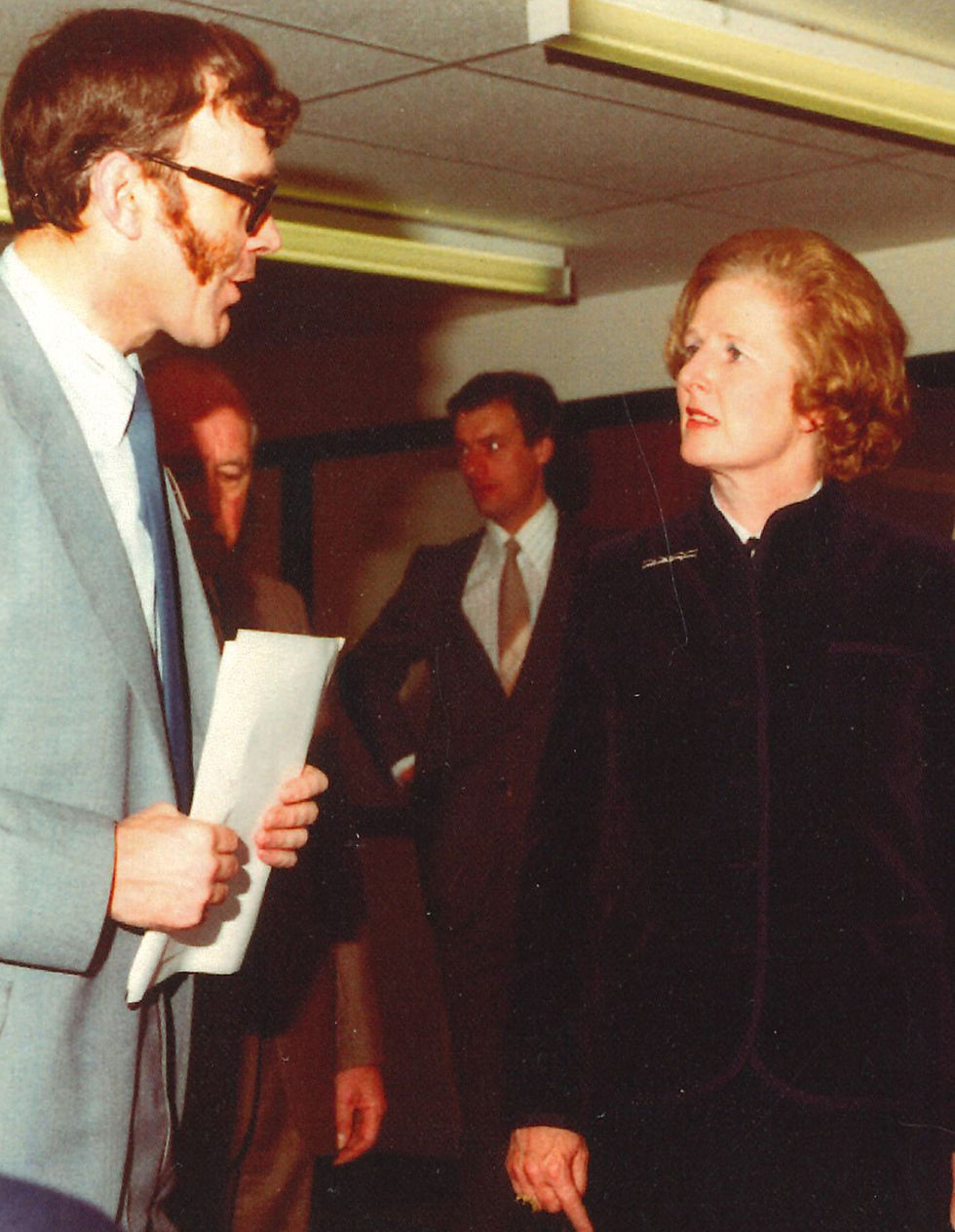
Prior to Margaret Thatcher becoming UK prime minister in 1979 Sir Ian would visit London and lunch with her almost monthly, and although he had many influential and famous friends, including J.K.Rowling, Warren Buffet and Sir Tom Hunter, as an extremely private man, he did not court publicity, nor did he use his wealth to court the company of those with a similar social standing. He was immensely proud of his personal friendship with the late Queen Elizabeth II and her son King Charles III. He was awarded a CBE in 1982, Knighted in 1994, and received the Carnegie Medal for Philanthropy in 2019. Later In 2019 his knighthood was elevated to that of “The Order of the Thistle” the highest civilian honour available in Scotland, as a personal choice of her Majesty Queen Elizabeth II before her passing.
Throughout his life he had a reputation for thrift and did not lead the extravagant financial life expected of billionaires. He didn't fly by private jet, had no exotic overseas holiday homes, and rarely carried more than £20 in his wallet at any one time. His one modest Indulgence, a home for weekend family retreats in rural Perthshire in Scotland. A former colleague tells a story of Sir Ian in a New York Hotel in 2002 refusing to pay the $38 for breakfast on the principled point that he felt it too expensive, and in 1978 he was extremely disappointed to read that his company was one of the highest paying employers in Scotland.
His grandfather William Wood, a fisherman and boat engineer, who came from Ross Shire in Northern Scotland with his family of 10 children in 1904, started the family firm Wood & Davidson around 1912. Predominantly a fishing boat repair business, the company progressed to running three of its own trawlers by 1918. Sir Ian's own father John Wood bought out the company around 1954 from his own siblings and his father Williams business partners Alex Davidson after his own fathers death.
Sir Ian was born in 1942, and grew up in Aberdeen, Scotland. He spent his early School years in private education at Robert Gordon's junior School. He had big ambitions while still at School and confided to one of his School friends when he was aged just 18, that he intended to reach the House of Lords by the time he was 40. As the school's outstanding student of the year for 1959 he won the prestigious Mackenzie scholarship prize, which consisted of a 6 week trip to South Africa, where he was hosted by one of the world richest families, “The Mackenzie” family whom originated from Perthshire in Scotland and owned much of the gold and diamond mines in the country. Sir Ian continued onto further education at Aberdeen University graduating in 1965 with an honours degree in Psychology. A gifted and academic sportsman, he tried out for the Scotland National Rugby team, and played against the mighty all blacks. Upon leaving University in 1965 he had secured a place at Medical School and was all set to become a doctor. However In 1965 he was asked to help out in the family fishing business for a temporary period until his father recovered from Illness. On his first day as a “temp”, with no guidance or training, he was simply sat in an office chair with his father stating little more than, you are now in charge of the trawler side of the business and his father simply walked out, as his father walked out of the office, his son replied “I won't be staying here to waste my life”. Sir Ian's impact inside the business was immediate, he transformed the business from a small boat repair yard, operating just 3 trawlers and 39 employees in 1965, to a 32 trawler operation, with 1500 employees by 1968. Seeing his son's success his father John stepped aside from the top role in the business in 1968.
With Oil & Gas having been discovered on the shores of the North Sea in the 1950s and 60s, Sir Ian foresaw an Oil boom few others predicted. In 1971 after a visit to an Oil show in Texas, he saw the future, and described it as his “Eureka” moment. He saw a mature Oil and Gas Industry in Texas, laden with technology, and expertise, that he knew would be needed in the UK, if the Oil & Gas finds being reported in the media, were proven commercially viable. Upon returning from Texas, completely against his fathers wishes, he purchased the old decaying John Lewis Shipyard in Aberdeen harbour for £1.25m, with the advent of money decimalisation, this was the first £1m business transaction in Scotland. With one eye on ship building, and another on the coming Oil boom, he saw his opportunity to get his new yard ready for the influx of steelwork fabrication the Industry would require before anyone else saw there would be a need.
His vision and risk taking saw him transfer the yard from a ship builder to a major Seagoing vessel repair centre and Oil Rig repair facility, servicing the new “Super Sized”ships exploring for Oil in the North Sea. Until that point, the only major ship builder Hall Russell in Aberdeen had the space and capacity to host.
Sir Ian was at the very heart of the new arriving Oil & Gas Industry, he was present at Shell building in Aberdeen, the very moment Shell Geologists announced internally the discovery of the Massive Brent Oil field in 1971, which was later to have extractable Oil reserves valued at £360bn. The 1970s saw his company Woodgroup, awarded huge maintenance contracts for the new Oil and Gas Rigs from BP and Shell and others whose assets had now started to produce most of the UKs Oil & Gas.
The 1980s saw Sir Ian's company expand into the lucrative business arena servicing aircraft jet engines and factory power turbines. Companies he bought and sold, serviced U.S presidential jet “Air Force one”, and the F14 aircraft used in the 1980s blockbuster movie Top Gun. His company prospered during the Oil slump of the mid 1980s, when most companies were shrinking and laying off workers. The downturn saw Oil companies transition out their own directly employed staff and transferred thousands of them through his company as contractors.
Tragedy befell his company in 1988, when 39 of his employees died during the world's worst Oil & Gas disaster, the tragedy on Piper Alpha in 1988, which killed 167 men. He never entirely got over it and it affected him during his personal moments for the remainder of his life..
The 1990s saw his company crack the South America Oil & Gas contractor market, winning the largest ever single Oil & Gas maintenance contract ever awarded to a Scottish company, when BP Columbia awarded a $1bn contract for maintaining Oil & Gas Assets in the country.
As the millennium approached Sir Ian had grand visions for company expansion, and he raised £200m floating 20% of his company on the London stock exchange, an IPO which was oversubscribed 7 fold.
One of his major life disappointments was his failure to secure a financial deal to rebuild a part of the city centre of his beloved hometown Aberdeen. He offered a financial package of £120m to build a new civic square revitalising the heart of Aberdeen. His deal involved the City Council of Aberdeen making a financial contribution similar to his own, to be funded in the exact same way as Dundee funded the Victoria and Albert Museum. The deal was rejected by the city's councillors The failure of the project haunted Sir Ian for the remainder of his life.
Ian's business style was non confrontational, he managed his companies by consensus, always valuing an opinion, his management style was not one of dictatorship, ultimately he made the final business decisions. Being tall at 6ft 3, Sir Ian would often kneel down or be seated in such a position as to deliberately ensure his eyeline wasn't higher than those who he was talking or negotiating with, his Psychology degree obtained from Aberdeen University in 1965 changed the way he interacted with people and how he behaved towards others. In tough meetings when negotiations were failing, Sir Ian would bring out and share around the room a packet of his favourite Mcvities digestive biscuits, which broke the ice of many deadlocked meetings.
Sir Ian commanded huge respect from those he both competed against and negotiated with, but he deliberately and always never intimidated. He was very self aware, and knew his status in society, but allowed few others to know, he knew. He met and negotiated with Kings, Presidents, and Billionaires, yet avoided being pictured in the media doing so.
His charity work with Wood foundation, a charity foundation he set up in 2007 after a conversation with Harry Potter author JK Rowling, and Scotland's Sir THomas Hunter, saw him donate and raise over $450m for tea farmers in Africa through a self sustaining charity initiative, taking 60,000 tea farmers out of abject poverty. Along with his son Garreth and Garreths wife Nicola he helped fund and set up the charity “Kidsor” (Kids Operating Room), which has performed operations on over 200,000 sick children in impoverished countries who otherwise would have no access to medical care. His charity contributions make him the second largest charity donor by financial monetary value in Scottish history after Steel Magnate Andrew Carnegie. He bequeathed £4.5m to Robert Gordons University in Aberdeen during his lifetime, the largest sum ever donated to a Scottish university by an individual, and along with his wife Lady Helen Wood, funded a £10m car park at Aberdeen Main hospital, Aberdeen Royal Infirmary.
He controversially awarded Donald Trump an honorary degree at Robert Gordon University while he was the university rector in 2010. In 2015 he famously gave a Speech in San Francisco at the personal request of Bill Gates and Warren Buffets annual “Just Giving Charity organisation” meet, where he stood on the podium and asked the 100 American based Billionaires assembled, Including Mark Zuckerberg, Elon Musk, and George Lucas, why they gave 95% of their money to the U.S.A’s already richest universities, instead of using it to fight poverty.
At the time of his retirement from Wood Group, Oil & Gas Tax revenues were declining, with that the UK government asked Sir Ian to produce a report into the entire workings of the UK OIl Industry so the government could assess how it could be improved commercially, in order for the Government to extract more revenue, The report would become the Wood Review and from it emerged a new Industry framework as to how the overall Industry should be managed..
As is true of the great achievers, Sir Ian never felt content with his own achievements. All success and achievement did was simply open his mind to the enlightenment that his achievements simply were not good enough. A life in continued pursuit of perfection and unfulfillment. Sir Ian wasn't like most fathers, he wasn't always able to be on the touchline of his children’s football games, he didn't always make enough time to watch them in the school play. He traded off, to forge and grow the companies he founded. Perhaps given the same life to live again, with the hindsight of his life, his life choices would likely not have been any different to those of the path he chose to walk.
He won't be recognised and talked about in the same breath as the well known entrepreneurs of this era, simply because he did not court publicity. However his success and achievements are as remarkable as any in all of history.
Aberdeen owes Sir Ian Wood a far greater debt than it would ever care to appreciate. His efforts were instrumental in bringing the Oil & Gas Industry to the city of Aberdeen, when it was originally bound for Dundee. This catalyst brought to Aberdeen the first of the large Oil companies who were starting to explore and prospect for Oil in British Waters at the dawn of the Oil age. The discovery of the Brent and Forties Oil fields in the early 70s, didn’t guarantee riches or long-term prosperity for the city of Aberdeen, the Industry was seen as a fad, here today gone tomorrow, Sir Ian made business bets and Invested against the general narrative. Most doubted there would be any real long-term change for the city. Sir Ian Wood, a “Gentleman” swashbuckling fighter, prepared to invest millions of borrowed money, without any guarantee of winning the business needed to support paying it back.
His is a story of huge risk, inspired strategy, and of the making of huge decisions against all those around him, guiding his business through success, tragedy, and failure and above all applying huge personal dedication to work, focused on the one direction needed, to make his companies a success.
Looking at the greatest Scottish Business leaders throughout history, Andrew Carnegie sits on his own as the most recognised and greatest Scots business leader in our country’s history, not just for the wealth he created but for the businesses and wealth he gave away.
Sir Ian Wood's achievements both in business and philanthropy put him very much in the same category.
Sir Ian Wood
The last of the true great “Industrialists”




Comments